Brighton yards are full of big, thirsty trees — cottonwoods, elms, and silver maples that have been growing for decades — and every one of them is looking for water. A sewer line is a year-round water source, and at every joint, crack, or loose connection it leaks a little moisture into the surrounding soil. Roots follow that moisture, slip through the smallest opening, and grow inside the pipe where the water and nutrients never run out. The result is the most common cause of recurring sewer trouble in older Brighton neighborhoods: a drain that clears, then slows again a few months later. This guide explains how roots get in, how a camera inspection confirms it, and the four real options — jetting, root treatment, spot repair, and pipe lining — with an honest look at what each one does and how long it lasts.
1. How roots get into a sewer line
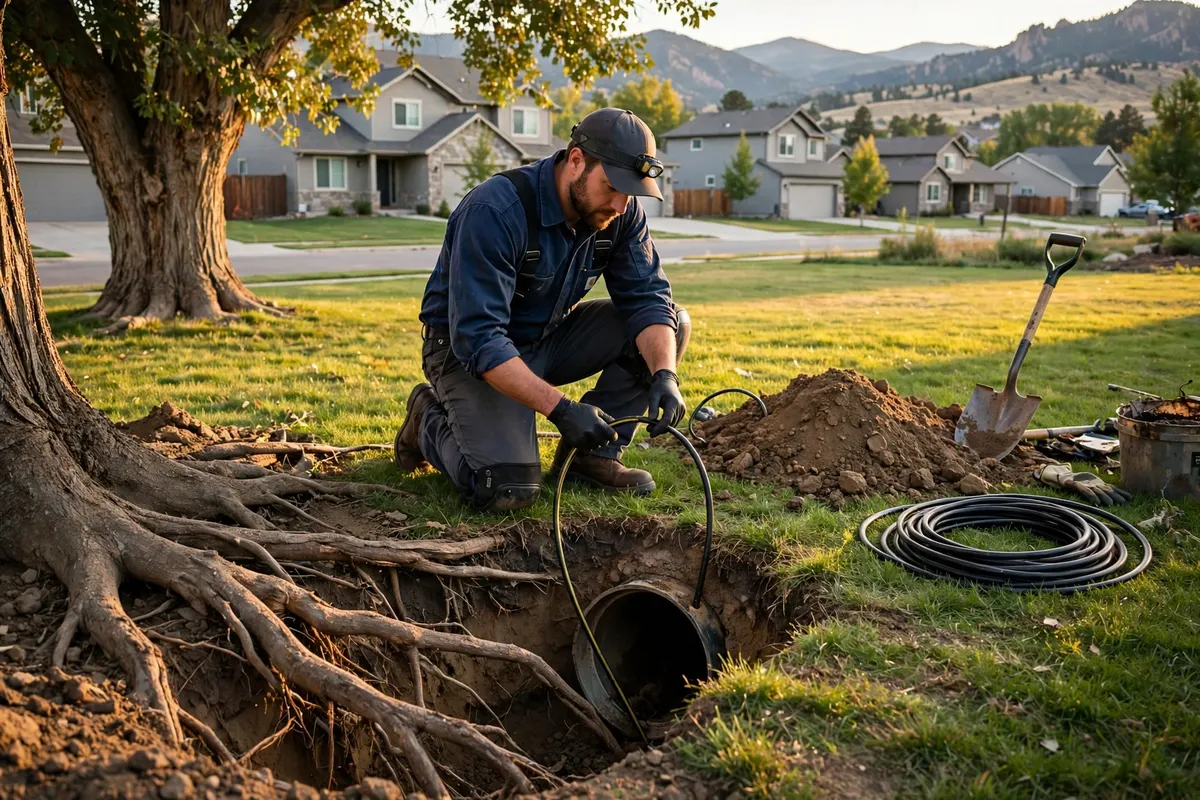
A healthy sewer line is sealed, and roots cannot get through solid pipe. The trouble starts at the weak points. Older Brighton homes often still have clay tile or cast-iron sewer lines, and clay pipe was laid in short sections with a joint every few feet — each joint is a seam where moisture escapes into the soil. Tree roots sense that moisture and send fine feeder roots toward it; a hair-thin root slips through a gap no wider than a sheet of paper, and once inside it finds a constant supply of water and nutrients. Inside the pipe the root grows fast, branching into a mat that catches toilet paper, grease, and everything else flowing past. The mat narrows the pipe, slows the flow, and gives the next flush something to snag on — which is why the first symptom is usually a drain that slows gradually, then a clog that keeps coming back no matter how often the line is cleared.
2. The signs — and how a camera inspection confirms it
Roots rarely announce themselves with a single dramatic event. They build up over months or years, and the early signs are easy to blame on something else:
The only way to be sure is a camera inspection. A small waterproof camera is fed through a cleanout into the line, and the picture shows exactly where the roots are, how much of the pipe they fill, and — just as important — the condition of the pipe around them. That last point decides the fix: roots in a sound pipe call for cleaning, while roots in a cracked or collapsed pipe call for repair. Without the camera, every fix is a guess.
- Several drains slowing at once, especially the lowest fixtures in the house
- Gurgling from a toilet or tub when another fixture drains
- A drain that clears after snaking, then clogs again within a few months
- A patch of lawn above the sewer line that grows faster and greener than the rest
- Sewage smells near a floor drain, or water backing up into a basement shower
3. Jetting clears it, treatment slows it down
Hydro jetting is the first step for most root problems. A hose with a spinning nozzle sends high-pressure water through the line, cutting the root mat away from the pipe walls and flushing it out. It restores full flow the same day, and because it cleans the whole line — not just the blockage — it also removes the grease and scale the roots were catching on. The catch is that jetting is a cleaning, not a repair: the roots are cut at the pipe wall, the entry point is still open, and the roots grow back. In a line with a small opening and a healthy pipe, that regrowth takes a year or two; with a wide crack, it can be a matter of months.
That is where root treatment comes in. After the line is jetted clean, a foaming root treatment is applied inside the pipe; the foam coats the walls and kills the roots it touches, including the fine feeder roots jetting can miss. A treatment does not repair the pipe, and it does not stop roots from finding the opening again — but it stretches the time between cleanings, and for many homeowners a yearly treatment after jetting keeps the line clear indefinitely. It is the lowest-disruption option there is: no digging, no new pipe, and the line stays in service. The honest limit is that it is maintenance, not a cure — if the pipe itself is failing, treatment only buys time.
4. Spot repair: replacing the damaged section
When the camera shows one bad joint or one cracked section and the rest of the pipe is sound, a spot repair is the permanent answer for that spot. The crew locates the problem from above using the camera's signal, digs down to that section, and replaces it — usually with modern PVC, which has glued joints and no seams for roots to exploit. The work is localised: one hole in the yard, one section of pipe, and the rest of the line is left alone. It is the right call when the damage is limited — a single root entry point, a short cracked run, or a joint that has shifted. It is the wrong call when the camera shows problems all along the line; replacing one section of a failing pipe leaves the next section to fail next year. The main disruption is the digging itself — a lawn, a driveway, or a walkway may need restoring once the pipe is back in the ground.
5. Pipe lining: a new pipe inside the old one
Pipe lining, also called cured-in-place lining, takes a different approach: instead of digging the old pipe out, a new pipe is built inside it. A flexible liner soaked in resin is pulled or pushed through the cleaned line, inflated against the old pipe walls, and cured in place with hot water or steam. The result is a smooth, jointless pipe inside the old one — no seams, no entry points, and a service life measured in decades. The line has to be cleaned first, and lining cannot fix a pipe that has collapsed or lost its shape, but for a line with several cracked joints it solves the root problem everywhere at once, without a trench through the yard. For Brighton homes with a mature tree sitting directly over the sewer line, that combination — no digging, no joints left for roots — is often the last root job the line ever needs. The choice between repair and lining comes down to the camera: one bad spot argues for repair, several bad spots argue for lining, and a sound pipe with roots argues for jetting plus treatment.