It usually starts quietly on a bitter Colorado morning: you turn on a faucet and nothing comes out, or only a thin trickle escapes while the rest of the house runs normally. Somewhere between that faucet and the main line, water has frozen solid inside a pipe — most often in a crawlspace, an unheated garage, an attic, or an exterior wall. A frozen pipe is not yet a disaster, but it is a countdown. Ice expands as it forms, and the pressure it builds can split a pipe; worse, the split often stays hidden until the ice melts and water starts pouring through the crack. Thawing it safely is mostly patience and method: gentle, even heat, in the right order, while you watch for signs the pipe has already failed.
1. Confirm it is frozen — and find where
A single faucet with no water while others run fine points to a frozen supply line feeding that fixture, not a problem with the whole house. If no faucet in the house produces water, the freeze may be at the main line or the meter — a different problem that usually needs a plumber. Start by opening the affected faucet a little, not all the way: this relieves pressure as the ice melts and gives melting water somewhere to go, which matters because trapped pressure is part of what bursts pipes. Then trace the line back from the faucet, feeling for the coldest, frostiest section. Frost on a pipe, a bulge, or a section far colder than the rest marks the frozen stretch. Check exposed spots first — crawlspaces, garages, exterior walls — and do not forget the hose bib line, the most common freeze point in Brighton homes.
2. Set the scene before you add heat
Before you warm anything, know where your main water shutoff is and make sure you can reach it quickly. If the pipe has already split, the moment the ice plug melts is the moment water starts flowing through the crack, and shutting off the main within a minute is the difference between a puddle and a flooded room. Keep the faucet open while you work, lay towels below the pipe so a leak shows at once, and move valuables out of the way. Watch the ceilings and walls below the run — a spreading stain or a new drip means the pipe has failed and the job has changed from thawing to damage control. If you see an obvious crack, a bulge ready to split, or water already seeping, stop and shut off the main.
3. Warm it gently, from the faucet end back
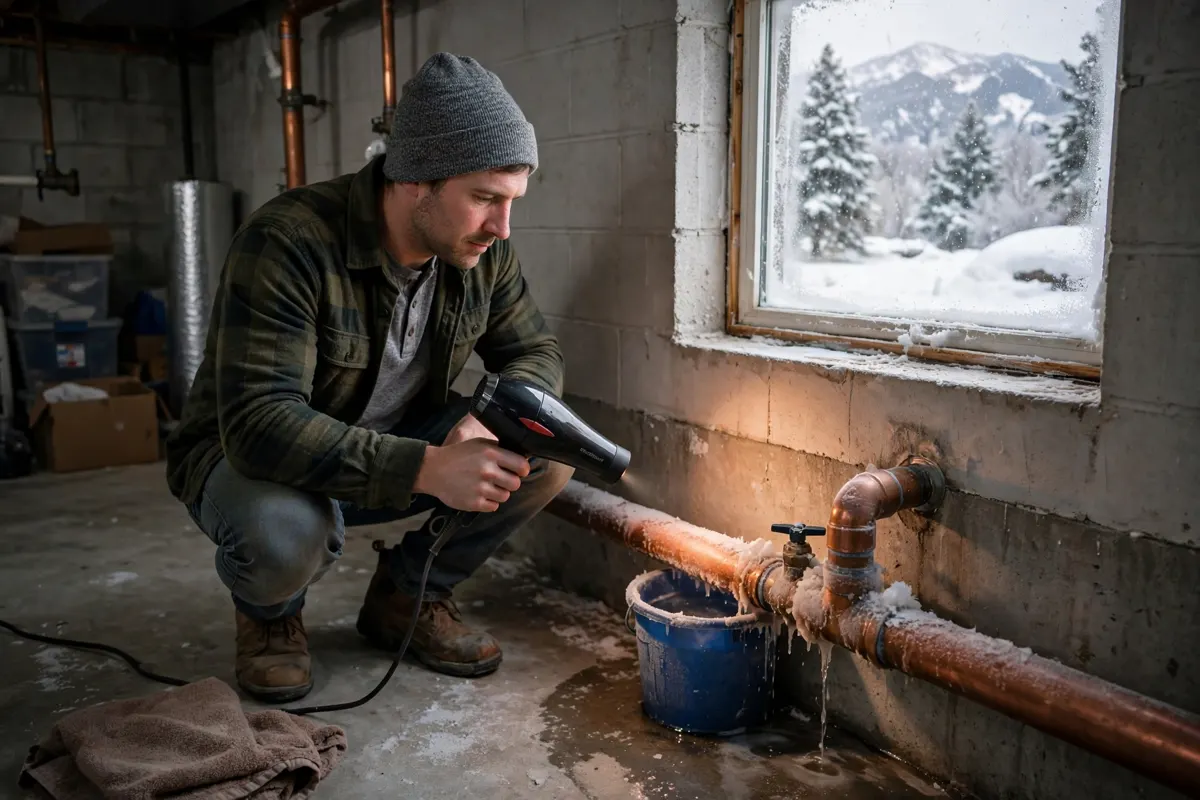
Safe thawing is slow thawing. A hair dryer on a medium setting, moved steadily along the pipe, is the best household tool: even, controllable heat without the concentrated blast that damages pipe and fittings. A heating pad wrapped around the frozen section works too, as does a towel soaked in hot — not boiling — water and wrapped around the pipe, re-soaked as it cools. Whichever method you choose, work from the faucet end back toward the coldest part, so meltwater escapes through the open tap instead of building up behind the ice plug. You will know it is working when the trickle grows into a steady stream. Expect time: a short section may clear in thirty minutes, a longer crawlspace run in an hour or more. Steady progress is the goal, not speed.
4. What never to do
The dangerous methods are tempting because they are fast — and they cause fires, cracked pipes, and injuries:
- Never use an open flame — no blowtorch, no propane torch, no candle. A torch can ignite wood framing, insulation, and dust inside a wall cavity, and it can overheat one spot on a pipe until it fails while the rest stays frozen.
- Never pour boiling water directly onto a frozen pipe. The sudden temperature shock can crack metal and split fittings, especially on older pipe that is already stressed.
- Never use a heat gun on its highest setting, and never leave any heat source unattended on a pipe. A heat gun concentrates far more heat than a hair dryer, and an unattended heater near insulation or stored boxes is a fire risk.
- Never ignore a frozen pipe and hope a warm day fixes it. The thaw will come whether you are watching or not, and an unnoticed split can run for hours before anyone sees the water.
- Never close the faucet while thawing. The open tap is what relieves pressure and shows you the moment flow returns — closing it traps pressure behind the melting ice.
5. When the water returns — and when to call for help
When the faucet runs at full strength again, the immediate crisis is over, but the job is not quite done. Check the whole run for leaks, slowly and carefully, including joints and fittings that may have cracked under ice pressure without an obvious split. Watch the area for a day or two for a slow drip at a fitting. Then think about prevention before the next cold snap: insulate the run, seal the air leaks that blew cold air onto it, and disconnect the garden hose from any outdoor bib on that line. Call a plumber if the pipe will not thaw, if you find a crack or leak, if the freeze is in a wall you cannot reach, or if no water comes out anywhere in the house. A frozen main line or a burst behind drywall is where professional tools beat another hour with a hair dryer — and where catching the problem early keeps a frozen pipe from becoming a flooded home.