Every homeowner knows the sound: a faint hiss from the bathroom that never quite stops, or a toilet that refills itself every few minutes for no apparent reason. It is easy to ignore, because the toilet still flushes and nothing leaks onto the floor. But a running toilet sends water straight from the supply line down the drain, around the clock — and over weeks that adds up to a surprising amount of wasted water, plus a water bill that creeps upward for no obvious reason. The good news: almost every running toilet comes down to one of three small parts inside the tank, diagnosable in minutes with the lid off.
1. First, find out where the water is going
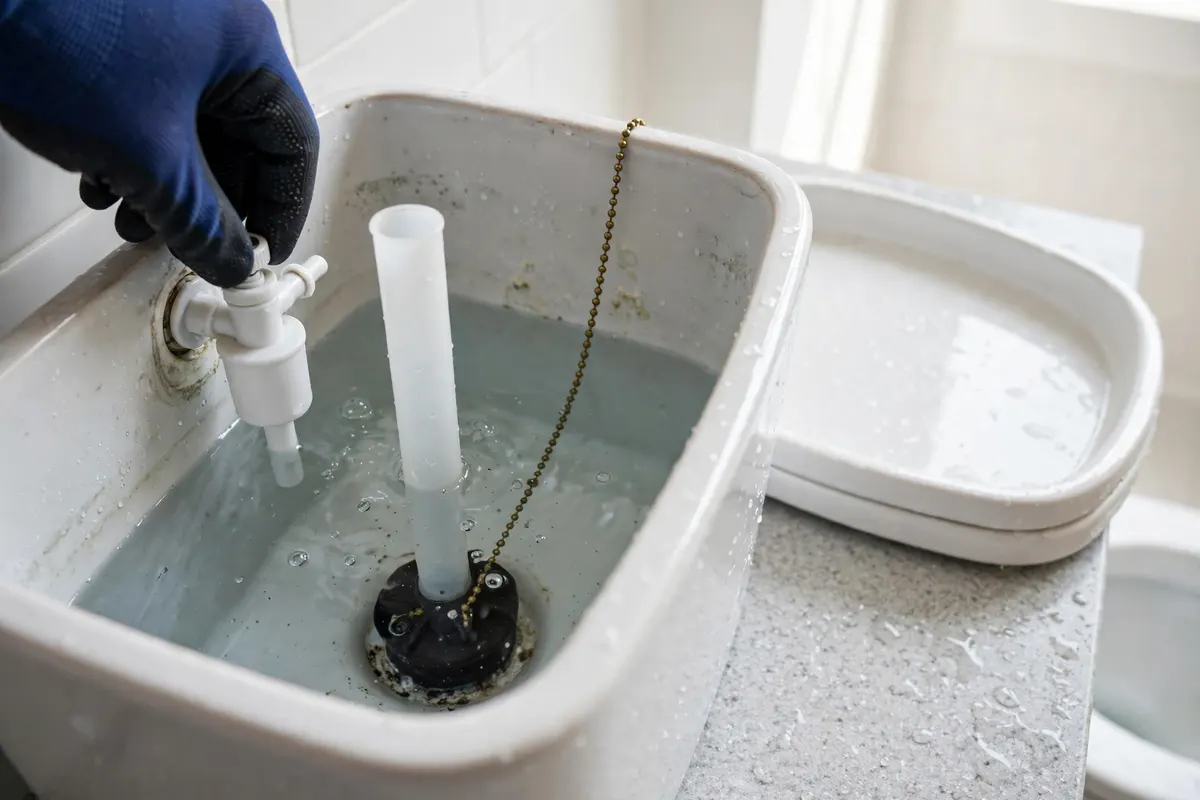
Lift the tank lid and watch. If the water level sits at the top of the overflow tube, or water trickles into it, the tank is overfilling — that points to the fill valve. If the level looks normal but the bowl refills itself, water is leaking tank-to-bowl — that points to the flapper. Confirm it with food colouring: a few drops in the tank, twenty minutes without flushing, then check the bowl. Colour in the bowl means water is slipping past the flapper; no colour but a refilling tank means the fill valve is the problem. One observation narrows it to a single part.
2. The flapper: the usual suspect
The flapper is the rubber disc at the bottom of the tank that seals the flush valve. Rubber wears out — Brighton hard water and chlorine accelerate that — and a worn flapper warps or stops sitting flat. Then tank water seeps into the bowl, the level drops, and the fill valve tops it up — the phantom refill most people hear at night. If the underside feels warped or leaves black residue, it is done. Check the chain too — it needs about half an inch of slack. A taut chain holds it slightly open; a too-long one can snag underneath. Flappers are sized to the valve, usually two or three inches, so measure before buying.
- Warped rubber or black residue means the flapper is worn out
- A chain with no slack holds the flapper open
- A too-long chain can snag under the flapper
- Match the replacement to your valve size
3. The fill valve: when the tank never shuts off
The fill valve, the tall assembly on the left of the tank, refills the tank after every flush and should shut off crisply at the set level. When it fails, it never fully shuts off, so water keeps spilling down the overflow tube, or it shuts off late and noisily. Hard-water scale is a common culprit: mineral deposits on the valve seals keep them from closing cleanly. Sometimes the fix is just an adjustment: the float rides too high, so lowering it solves the problem in seconds. If adjustment does not help and the valve is several years old, replace it: a new fill valve restores a clean shut-off and a quiet refill.
4. The overflow tube: set too high, or cracked
The overflow tube is the open pipe in the middle of the tank that stops a faulty fill valve from flooding your bathroom — water above its rim drains safely into the bowl. It should never carry water normally, so a trickle into it means the fill valve level is set too high. Set the water level about an inch below the top of the tube. But the tube itself can be the problem: a crack leaks tank water straight into the bowl, mimicking a bad flapper, and no flapper replacement will fix that. If a new flapper does not stop a confirmed leak, inspect the tube for a hairline crack near its base. A cracked tube means replacing the flush valve assembly — a job most homeowners hand to a plumber.
5. When a running toilet is a symptom, not the problem
Most running toilets are one worn part in the tank, but a few patterns deserve a second look. If several toilets start running at once, or tanks refill with gritty water, the trouble may be upstream — sediment or high pressure stressing every valve. A failed pressure regulator can push pressure high enough to defeat fill valves one after another, and that is worth checking before replacing parts toilet by toilet. And if a new flapper and an adjusted fill valve have not fixed it, stop swapping parts: the flush valve seat may be pitted or warped, and a plumber can confirm that in one visit.