The garbage disposal is the hardest-working appliance nobody thinks about — until the morning it hums instead of grinding, drips onto everything stored under the sink, or simply refuses to start. The good news is that most disposal problems announce themselves clearly, and the symptom usually tells you whether you are looking at a five-minute fix, a repair worth calling about, or a unit that has reached the end of its life. Here is how to read what your disposal is telling you — and the one safety rule that comes before all of it: never put your hand inside a disposal, even when it is switched off.
1. Humming but not grinding: a jammed flywheel
A disposal that hums when you flip the switch but does not grind is almost always jammed. Something — a bone fragment, a bottle cap, a piece of silverware — is wedged between the flywheel and the grinding plate, and the motor is straining against it without turning. Switch the unit off immediately: a motor left humming will overheat and trip its overload protector, and repeated attempts can burn it out. With the power off and the unit unplugged, shine a flashlight down the drain; tongs or pliers can lift out anything visible from above. Most disposals also have a hex socket on the bottom: working the matching Allen wrench back and forth by hand frees the flywheel in many jams. Once it turns freely, restore power, press the small reset button on the bottom, and run cold water while you test it. If the flywheel will not budge by hand, or the motor still only hums after a reset, stop and call for help rather than forcing it.
2. Leaking under the sink: find the exact source first
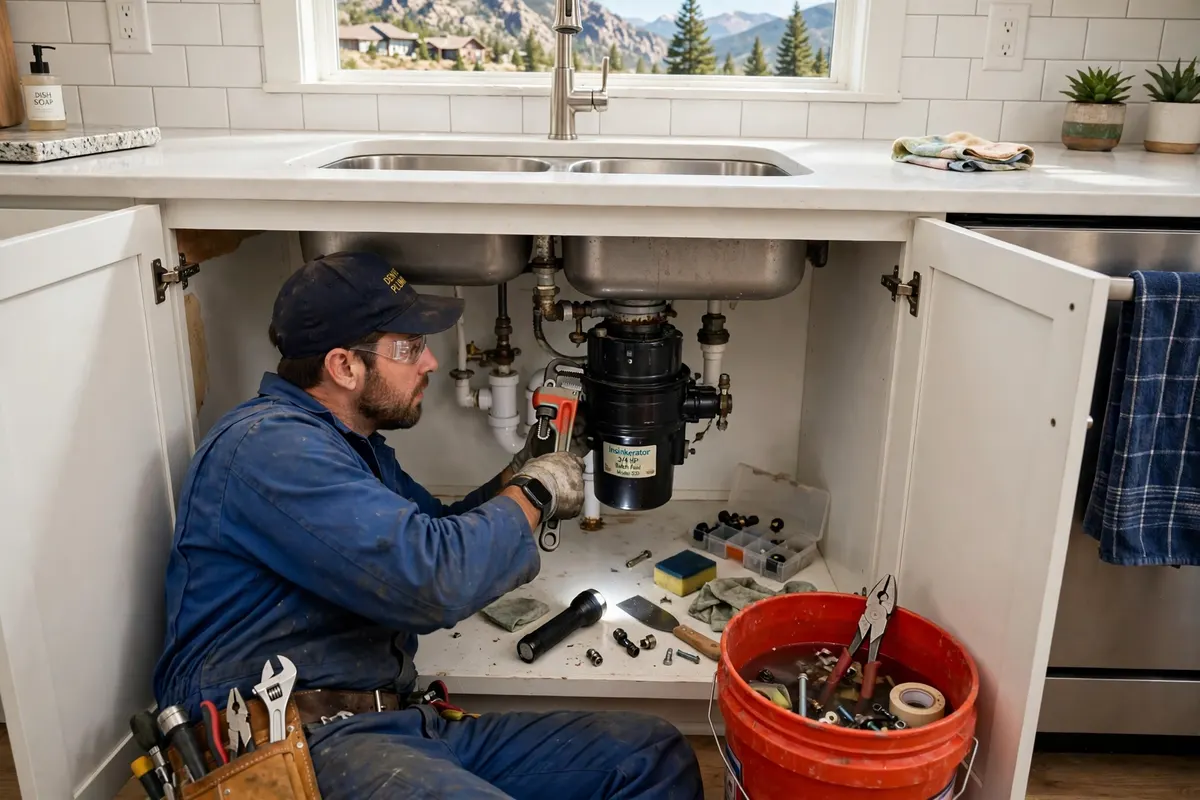
A puddle under the kitchen sink gets blamed on the disposal more often than the disposal deserves, so start by finding exactly where the water comes from. Dry everything under the sink, lay a dry towel beneath each connection, then run the faucet and the disposal separately and watch. Water dripping from the top, where the disposal meets the sink flange, usually means the mounting seal has failed — a straightforward repair. Water at the side connections points to the dishwasher inlet hose or the drain pipe joint, which may need only a tightened clamp or a new gasket. Water seeping from the bottom of the disposal body itself is the bad news: an internal seal has failed, and internal seals are not a practical repair on most residential units. A bottom leak also gets worse quickly, soaking the cabinet floor. Move stored items out, put a container under the drip, and do not keep running a disposal that leaks from its own housing — that unit is telling you it is done.
3. Completely dead: check power before you assume the worst
A disposal that does nothing at all — no hum, no click, no vibration — is often a power problem rather than a dead motor, so work through the simple checks before writing the unit off:
- Make sure the wall switch is on and that nobody has tripped the circuit breaker for the kitchen circuit — a tripped breaker is the most common cause of a suddenly dead disposal.
- Press the reset button on the bottom of the unit. It is a small red or black button that pops out when the motor overloads, and it must be pressed firmly to restore power.
- Check whether the outlet itself works by plugging in something else. Disposals wired through a GFCI outlet can go dark when the GFCI trips, and the reset for that lives on the outlet, not the disposal.
- If power is confirmed at the outlet, the switch works, and the reset button does nothing, the motor or its internal wiring has likely failed. At that point a replacement is almost always the sensible call.
4. Repair or replace: how to make the call
The decision comes down to age, symptom, and history. A disposal under five years old with a jam or a loose connection is usually worth repairing — the unit has years of life left, and the fix is simple. A disposal that leaks from its own body, needs repeated resets, or has already been repaired more than once is a different story: internal seals and motors are not designed to be rebuilt, and each new symptom is a sign the whole unit is wearing out. Most residential disposals last roughly eight to twelve years; a unit past ten that starts acting up is rarely worth a repair visit when a new unit brings a fresh warranty and quieter grinding. Whatever you decide, do not live with a leaking disposal for weeks — the cabinet damage underneath it grows silently until a disposal swap becomes cabinet work as well.
5. Habits that keep the next disposal alive longer
Disposals fail early mostly because of what goes into them. Cold water, always: run a strong stream before, during, and for twenty seconds after grinding, because cold water keeps grease solid so it flushes through instead of coating the pipes. Feed food in small batches and let the unit finish grinding before adding more. Never put grease, oil, coffee grounds, pasta, rice, potato peels, or fibrous vegetables like celery down the disposal — they expand, tangle, or congeal into the clogs that jam flywheels and block drains. Large bones and anything non-food — bottle caps, twist ties, silverware — cause the jams in section one. A disposal treated this way lasts longer and protects the drain line downstream, where the bigger problems live.