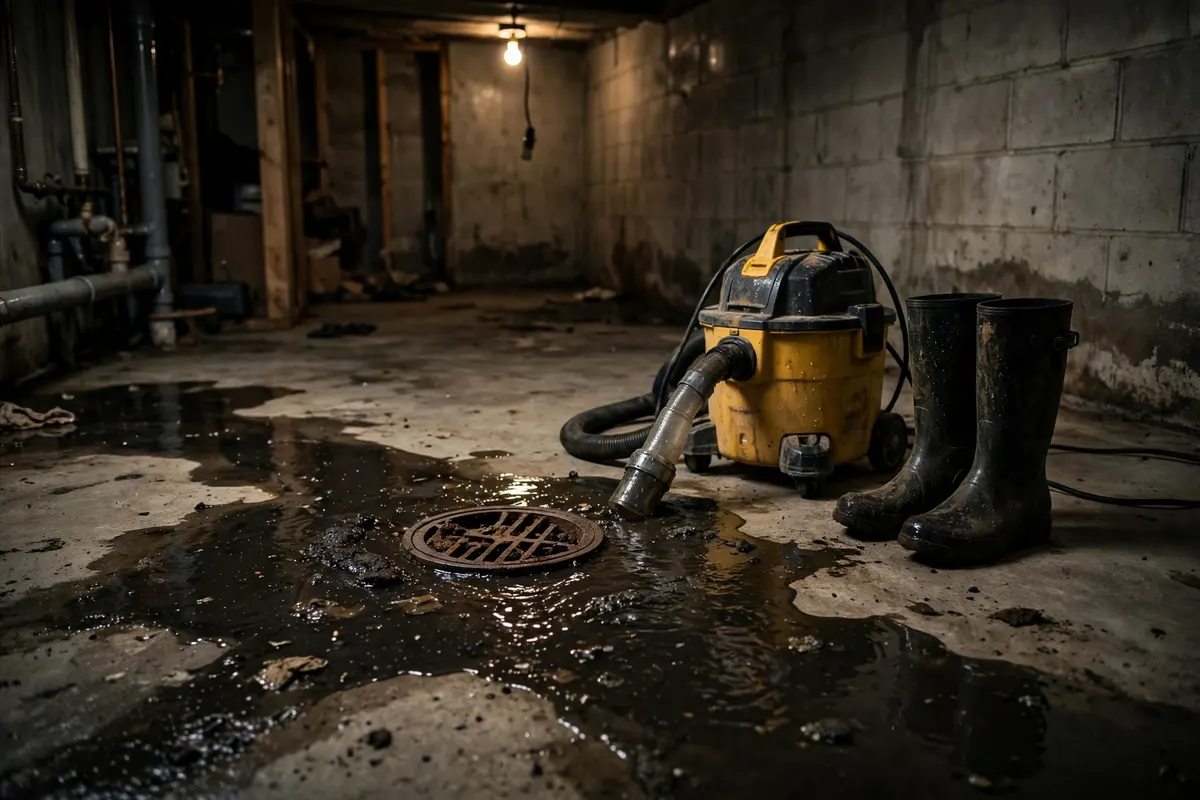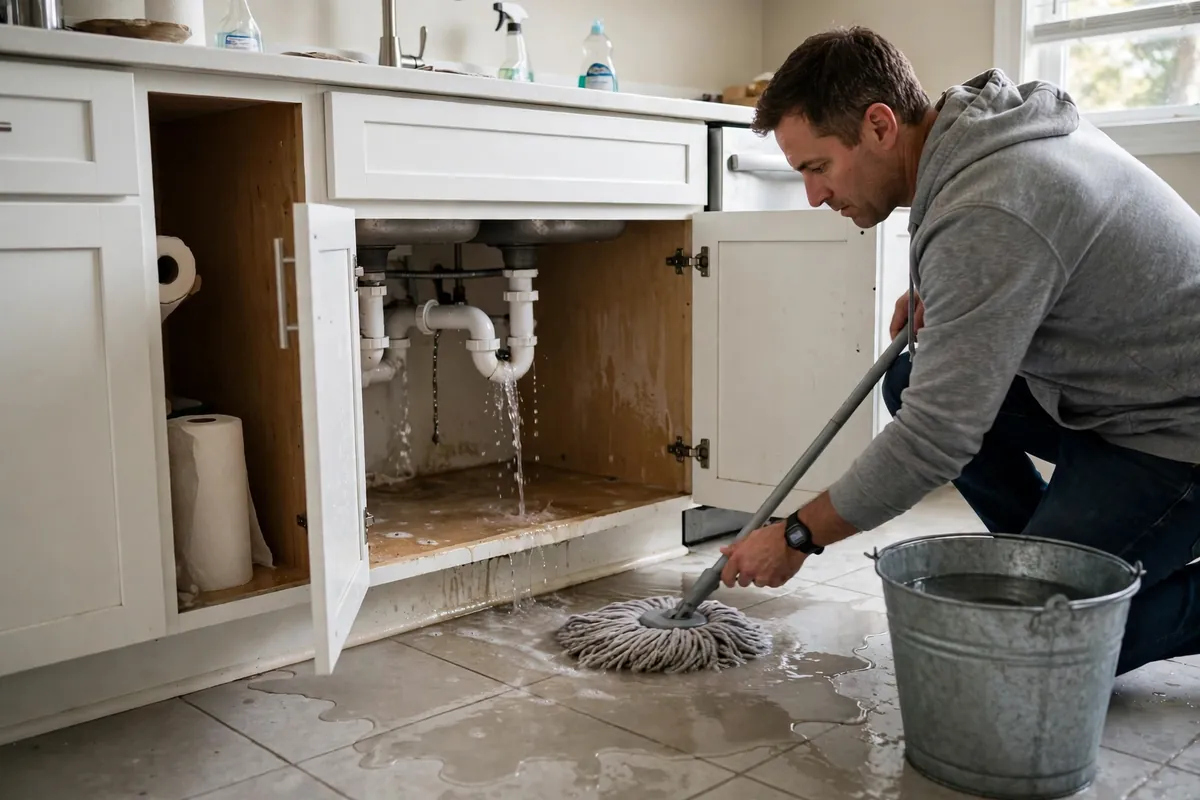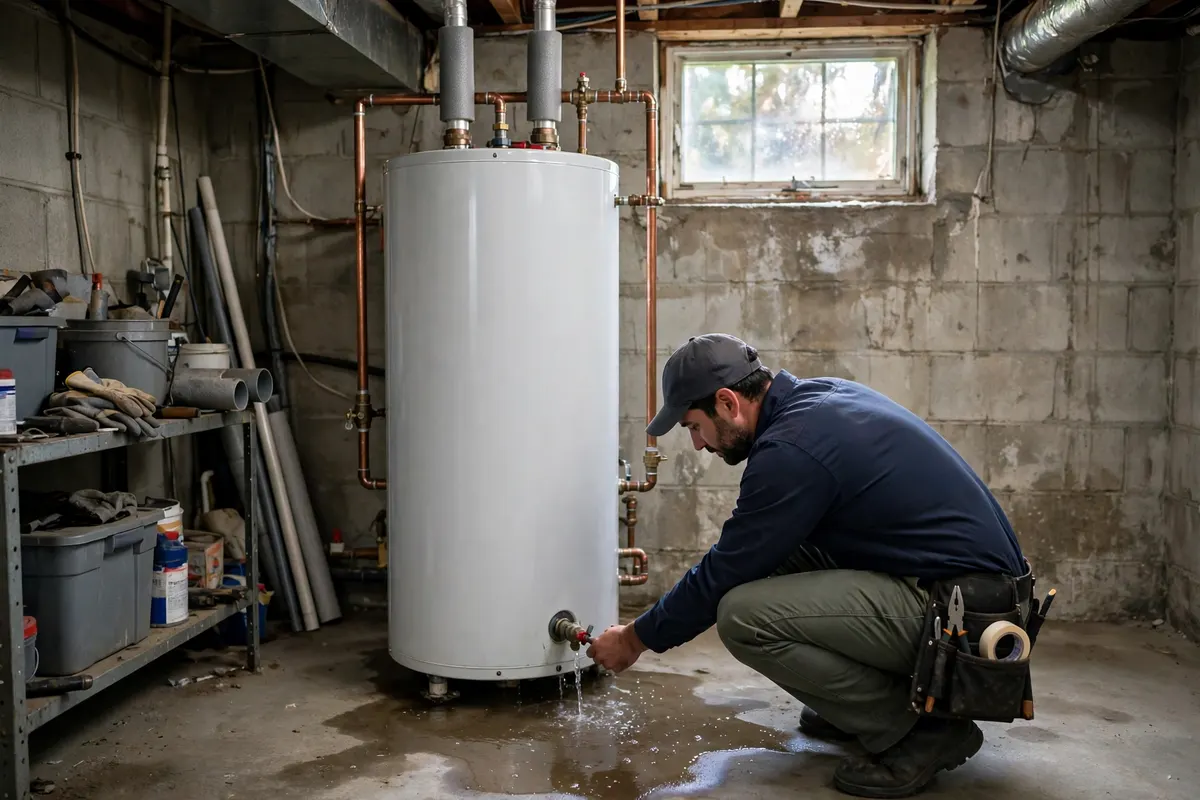
You walk into the utility room and there it is: a puddle under the water heater, or a damp ring on the concrete that was not there last week. The first instinct is usually to mop it up and hope it was condensation — and sometimes, in a humid basement, a little surface moisture really is just condensation. But a puddle that returns after you dry it is a leak, and a leaking water heater only goes one direction: worse. Forty or fifty gallons of stored water, plus a supply line that never stops feeding it, can flood a basement or garage in hours. The good news is that where the water is coming from tells you almost everything about what happens next — and the first steps are the same whatever the cause.
1. First: stop the water and the heat
Before you diagnose anything, make the unit safe. Turn off the cold-water supply valve on the pipe entering the top of the heater — turn it clockwise until it stops. Then cut the heat source: for a gas heater, turn the gas control knob to pilot or off; for an electric heater, switch off its dedicated breaker. If water is pooling near electrical components or the breaker panel, do not reach through standing water to get to them — call for help instead. With the supply off and the heat off, the leak should slow to a trickle or stop, and you have bought yourself time to look properly. Put down towels to protect nearby stored items, but do not drain the tank yet — a half-drained tank can be damaged by its own burner or elements, and draining is part of the repair, not the first-aid.
2. Find exactly where the water is coming from
Dry the floor around the base completely, then watch for ten minutes. The origin narrows the diagnosis fast. Water dripping from the small spigot near the bottom is the drain valve — these weep when sediment or a worn washer keeps them from sealing, and they are often the cheapest fix on the whole unit. Water running down the side from a pipe that ends a few inches above the floor is the temperature-and-pressure relief valve discharge pipe: that valve opens when pressure or temperature inside the tank climbs too high, and it is doing a safety job, not failing randomly. Water seeping from the bottom seam itself, or from rust streaks low on the tank jacket, points at the tank — internal corrosion that has finally broken through. And water appearing at a pipe joint on top is usually a fitting or supply connection, not the tank at all. Take a photo of what you find; it helps the technician bring the right parts.
3. What each cause actually means
A drain valve drip is usually a straightforward repair: the valve can be capped temporarily in some cases, but replacing it is the lasting fix, and it is often done during a flush that clears the sediment that caused the problem. A relief valve that keeps discharging is a symptom, not the disease — the usual culprits are a failed expansion tank, a closed system with nowhere for heated water to expand, or a thermostat running too hot. Replacing the valve without fixing the pressure problem just buys you a second discharge. A leaking tank seam, though, is the end of the road for that unit: once corrosion has eaten through the steel, no sealant or patch holds under pressure, and replacement is the only safe answer. Brighton hard water makes this timeline shorter than the national average — sediment accelerates corrosion, and heaters that were never flushed fail at the bottom first, right where sediment sits.
4. What never to do with a leaking water heater
Some well-meant moves make a bad situation dangerous:
- Never plug, cap, or block the relief valve discharge pipe. That valve is the tank's last safety device — blocking it turns a pressure problem into an explosion risk.
- Never ignore a small, steady puddle because it seems manageable. Tank leaks grow, often suddenly, and a slow leak over a weekend can become a flooded floor.
- Never keep resetting a tripped breaker or relighting a pilot on a heater that is leaking. Electrical faults and water do not mix, and a burner firing into a partially drained tank damages the unit further.
- Never pour leak sealant into a water heater. It contaminates the tank, voids any remaining warranty, and does nothing for corrosion that has already broken through steel.
5. Repair or replace: how to decide
The decision comes down to age, cause, and condition. A heater under eight years old with a valve or fitting leak is almost always worth repairing — the tank itself likely has years left, and a valve swap plus a flush can reset the clock. A heater past ten years, especially one that has never been flushed in hard-water country, is a different calculation: the tank is already at the age where corrosion wins, and money spent patching one leak often precedes the next. When replacement is the call, same-day swap-outs are common — standard 40 and 50-gallon units are widely stocked — and the new install is the moment to fix the root causes: an expansion tank if pressure was the issue, a proper drain pan and drain line if the location allows, and a flushing schedule you will actually follow. Whatever you decide, do not let a leaking heater sit through another week of slow drips. The floor underneath it is keeping score.