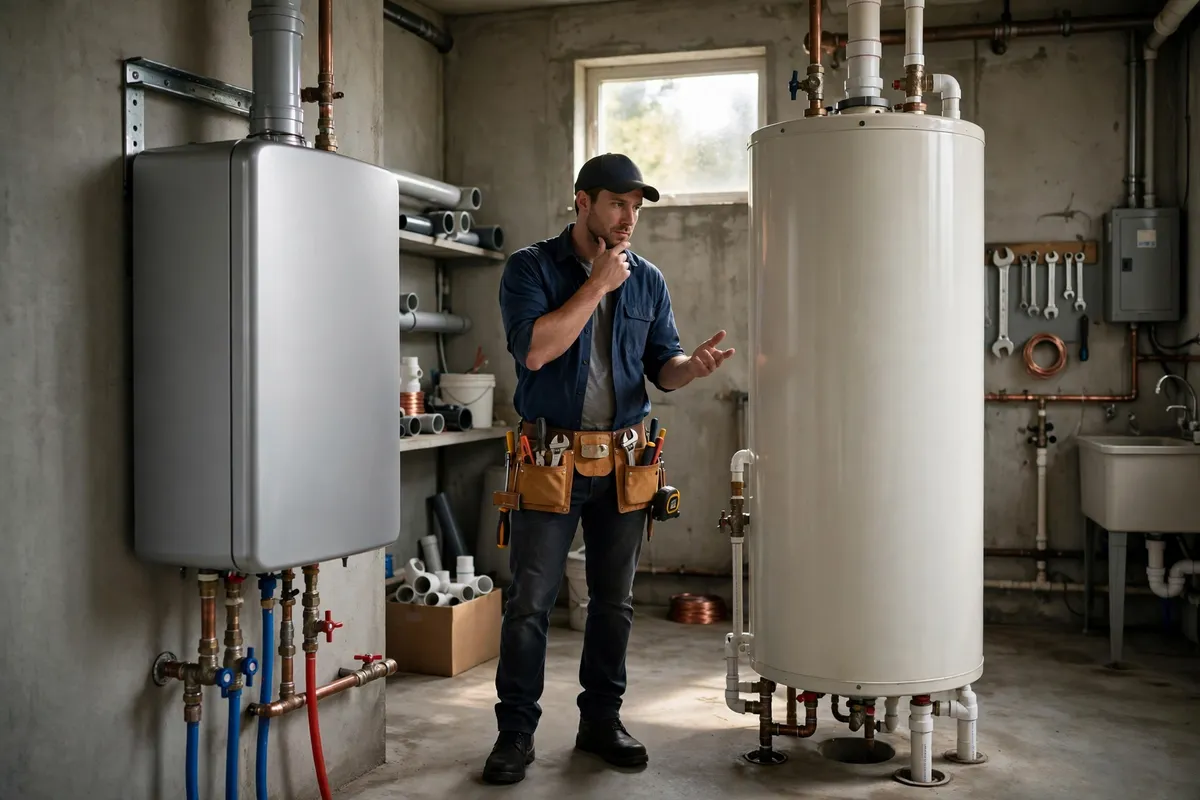
When a Brighton water heater dies, the replacement conversation almost always lands on the same question: stick with a tank, or go tankless this time? National guides answer it with national averages. Northern Colorado adds two local twists — altitude, which derates gas appliances, and hard water, which punishes any heat exchanger that's never descaled. Here's the comparison we'd walk through at your kitchen table.
How each one works, in one paragraph each
A tank heater keeps 40–75 gallons of water hot around the clock, ready for use, reheating as it empties. Simple, proven, and inexpensive to buy — but it pays a continuous 'standby' cost keeping water hot at 3 a.m. when nobody needs it, and when the stored water is gone, it's gone until the tank recovers. A tankless (on-demand) unit heats water only as it flows through, so there's no standby loss and no stored limit — but its output is capped by flow rate: it can supply endless showers in sequence, yet simultaneous heavy draws (two showers plus a dishwasher) can exceed a small unit's capacity.
The Colorado factors most guides skip
Altitude: gas appliances lose roughly 4% of their capacity per 1,000 feet of elevation, and Brighton sits near 5,000 feet. A tankless unit must be sized for derated output in winter, when incoming water is near freezing and the unit works hardest — undersizing decisions made from sea-level spec sheets are the top cause of 'tankless doesn't work' complaints here. Hard water: tankless heat exchangers have narrow passages that scale up fast without annual descaling; a tank tolerates neglect longer but pays for it in sediment and shorter life. Either way, in our water, maintenance isn't optional — it's the price of the lifespan on the brochure.
Costs: the honest comparison
Installed cost is where the tank wins clearly: a like-for-like tank swap is the least expensive path, while tankless usually requires gas-line upsizing, new venting, and electrical work on top of a pricier unit. Operating cost favors tankless (no standby loss, higher efficiency), and lifespan favors it too — 15–20 years versus 8–12 for a tank in hard water. Over a full service life, a well-sized tankless in a high-use household often wins on total cost; in a low-use household, the tank's lower upfront price may never be caught.
Which homes suit which
Tankless tends to fit: households that run out of hot water, anyone planning to stay in the home long-term, tight utility spaces (a wall-mounted unit frees real floor area), and homes with a softener or a willingness to descale annually. A tank tends to fit: tight replacement budgets, emergency swaps where hot water must return today, lower-use homes and rentals, and situations where the gas line and venting make tankless conversion disproportionate. There's no universal right answer — there's a right answer per house, usage pattern, and budget.
Either way, protect the investment
Whichever you choose in Brighton's water, the maintenance is what delivers the promised lifespan: annual flushing for tanks, annual descaling for tankless, anode rod checks on tanks every few years, and ideally softened water feeding either. Budget for that care when you compare, and both technologies will treat you well.